Push Notification A/B Testing: A Framework for Day-7 Retention Wins
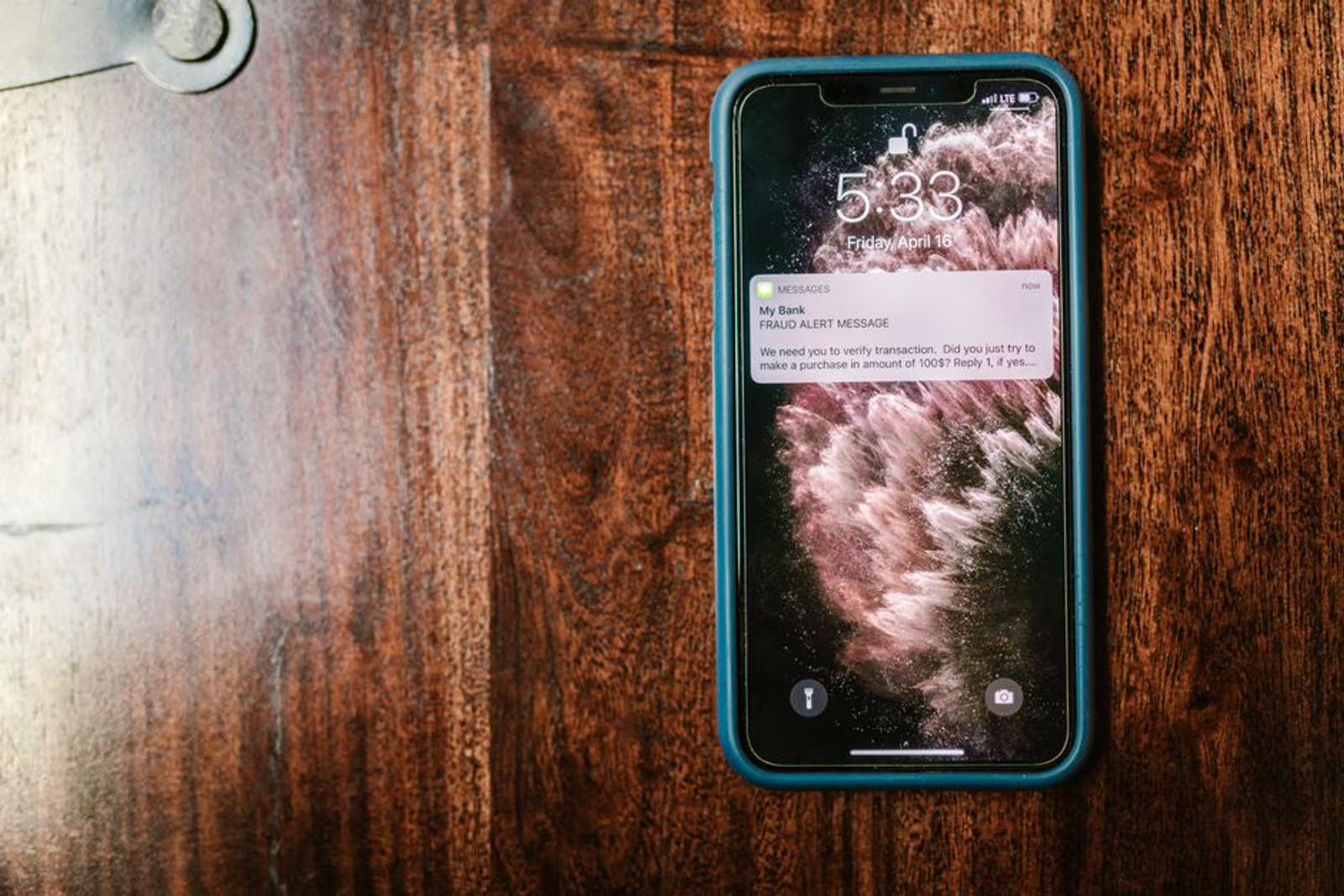
Most apps lose more than half their users before Day 7. That's not a secret — it's an industry-wide reality. What separates apps that claw their way to a healthy Day-7 retention rate from the ones that bleed out early is rarely the onboarding flow or the paywall design. More often, it's whether someone took push notifications seriously enough to test them systematically.
This post lays out a concrete framework for doing exactly that. Not "send more pushes" advice. A structured A/B testing approach with decision rules you can run starting this week.
Why Day-7 Retention Is the Right Lever
Day-1 retention tells you whether your onboarding landed. Day-30 retention tells you whether your core loop is sticky. Day-7 retention sits at the inflection point — it's predictive of long-term engagement in most app categories, and it's early enough that push notifications can meaningfully influence it.
A user who opts into push during install is giving you a direct line. If you're not using structured tests to figure out which message, timing, and tone actually brings them back, you're leaving the most controllable retention variable on the table.
The goal here is not to maximize notification volume. It's to find the combination of variables that converts a passive installer into a Day-7 active user — and to do it with a process you can repeat across cohorts.
The Variables Worth Testing (and the Ones That Aren't)
Not all test variables produce learnable signal. Here's how to prioritize:
High-signal variables:
- Copy angle — benefit-driven ("You're 3 days from your goal") vs. loss-aversion ("Don't lose your streak") vs. curiosity ("Something happened while you were away")
- Send time — morning (7–9am), midday (12–1pm), evening (6–9pm) relative to the user's local timezone
- Day of send — Day 1, Day 2, Day 3 within the first week window
- Personalization token — first name, in-app behavior reference, progress metric
Low-signal variables (save for later):
- Emoji vs. no emoji — produces inconsistent results across demographics and OS versions
- Subject line length alone — rarely the root cause of open rate differences
- Icon/image variants — harder to isolate causally on most measurement stacks
Run one high-signal variable per test. If you change copy angle and send time simultaneously, you won't know which one drove the outcome.
Sample Size and Cohort Structure
This is where most teams cut corners and end up with noise dressed as insight.
For push notification tests targeting Day-7 retention, you need to think in cohorts — not total installs. A cohort is the group of users who installed during a defined window and received your test variant.
Minimum viable cohort per variant: approximately 500 users who opted into push notifications. Not 500 installs — 500 push-enabled users. Push opt-in rates typically run between 40–70% depending on category and how you prompt, so plan your install volume accordingly.
| Variant | Push-Enabled Users Needed | Why |
|---|---|---|
| Control | ~500 | Establishes baseline Day-7 rate |
| Test A | ~500 | One variable changed |
| Test B (optional) | ~500 | Second angle if running multivariate |
| Buffer for attrition | +15–20% | Accounts for uninstalls before Day 7 |
If you're running paid acquisition to fill cohorts, factor this into your app marketing metrics planning from the start. Cohort-level testing is meaningless if your traffic mix shifts mid-test (e.g., you run a TikTok burst campaign in week two that changes your user quality).
Cohort isolation rule: start each test on a Monday, lock the cohort at 7 days of installs, and don't cross cohorts. Day-7 results are read 7 days after the last install in the cohort window — so a 7-day install cohort takes 14 days total to fully resolve.
The Test Sequence: What to Run First
Don't start with the most creative hypothesis. Start with the variable that has the highest expected variance across your user base.
Round 1 — Send timing. Run three cohorts: early morning, midday, and evening sends on Day 2 post-install. Use identical copy across all three. This tells you when your users are actually reachable before you optimize what you say to them.
Round 2 — Copy angle. Once you've locked the optimal send window, test three copy angles: benefit-driven, loss-aversion, and curiosity/FOMO. Keep the send time fixed at your Round 1 winner.
Round 3 — Personalization. Take your Round 2 winner and add a personalization token vs. a generic version. At this stage you're refining, not discovering.
This sequencing matters. Teams that jump straight to copy testing without knowing when their users open notifications often find that "the copy didn't work" when the real problem was they were sending at 2pm to an audience that's only on their phone at 8pm.
Need help structuring a cohort-based testing plan for your app? The Semnexus mobile app marketing team runs retention-focused growth programs for apps at every stage — from first cohort to scaled UA. Let's look at your numbers.
Decision Rules: When to Call a Winner
Statistical significance is the right standard, but in practice most app teams are working with cohorts that are too small for 95% confidence within a reasonable timeframe. Here's a pragmatic decision framework:
Call a winner if:
- The variant outperforms control by more than 3 percentage points on Day-7 retention AND
- Both cohorts have at least 400 resolved users AND
- The difference has held for at least 3 cohort windows in a row (i.e., it's repeatable)
Call it inconclusive if:
- The difference is under 2 percentage points
- Cohorts are under 300 resolved users
- The pattern reverses between cohort windows
Kill a variant if:
- Day-7 retention is lower than control by more than 2 percentage points
- Unsubscribe/opt-out rate increased materially (typically more than 1.5× control)
Don't let inconclusive tests run forever hoping the numbers will improve. If you have four cohort windows of noise, the variable probably doesn't matter as much as you thought. Move to the next one.
For more on building disciplined testing pipelines, the 12-week creative testing pipeline for app install ads covers similar decision logic applied to paid creative — the frameworks translate well.
Tracking the Right App Marketing Metrics
Day-7 retention is the primary metric. Everything else is diagnostic.
Secondary metrics to track alongside Day-7:
| Metric | What It Tells You |
|---|---|
| Push open rate | Whether the message is compelling enough to act on |
| Click-through rate | Whether the deep link destination matches intent |
| Opt-out rate | Whether frequency or tone is causing damage |
| Day-7 session depth | Whether push-returned users are actually engaging |
| Revenue per cohort | Whether retained users monetize differently across variants |
Don't optimize for open rate alone. An aggressive loss-aversion message can generate opens while simultaneously training users to opt out — and a 5% opt-out spike in a single cohort has compounding effects on every subsequent test.
Session depth on Day 7 is undertracked by most teams. A user who opens the app for 30 seconds after a push and immediately closes it is not the same as a user who completes a core action. Make sure your analytics stack (GA4, Mixpanel, Amplitude — whichever you're using) is capturing session length and core action completion for push-attributed sessions separately.
FAQ
How many push notifications should I send in the first 7 days?
Typically 2–4 across the first 7 days is a reasonable starting range. More than that risks opt-outs before you can measure Day-7 retention meaningfully. In our engagements, apps in habit-formation categories (fitness, language learning, daily check-ins) can push toward the higher end; utility apps and marketplaces should stay conservative until testing shows users will tolerate higher frequency.
Does iOS vs. Android change the testing approach?
Yes, in a few specific ways. iOS requires an explicit opt-in prompt, so your push-enabled cohort is self-selecting for higher intent. Android historically had higher default opt-in rates, though this has narrowed with Android 13+ requiring explicit permission. You should segment your analysis by OS — what works for your iOS cohort may not work identically for Android.
Can I run push notification tests without a dedicated CRM or push platform?
You need at minimum a push platform that supports cohort-level scheduling and delivery tracking. OneSignal, Braze, Klaviyo, and Iterable all support this at various price points. Doing this from a raw Firebase integration without a CRM layer is technically possible but makes cohort isolation and reporting significantly harder.
What if my app has fewer than 500 push-enabled users per cohort?
Work with what you have, but be honest about the confidence level. With smaller cohorts (200–400 users), treat results as directional signals rather than conclusive wins. Run more cohort windows before making permanent changes. The risk of acting on small-sample noise is implementing a worse variant at scale.
Should the Day-2 and Day-4 push use different copy angles?
Yes, once you've validated your timing in Round 1. Day 2 is typically a re-engagement prompt — the user hasn't fully habituated yet. Day 4 is a check-in push — you're reinforcing progress or nudging toward a second meaningful action. Different moments in the user journey call for different angles. Don't reuse the same message template across both.
How does push notification testing fit into a broader retention strategy?
Push is one retention channel, not the whole strategy. It works best when it complements in-app prompts, email (where you have addresses), and a solid core loop. If your Day-1 retention is under 25%, fix the onboarding before optimizing pushes — you're filling a leaky bucket. For a broader look at acquisition and retention together, 12 Ways Mobile App Marketing Agencies Use to Give an Impetus to New Apps is worth reading alongside this framework.
Push notification testing is one of the highest-leverage, lowest-cost retention tools available to app teams — and most teams run it ad hoc at best. A structured cohort approach with clear decision rules changes that. If you're building or scaling an app and want a second set of eyes on your retention metrics and messaging strategy, book a 30-minute call or explore what the Semnexus mobile app marketing team does for apps at every growth stage.